HCOMP/CI 2026: Shaping the Handbook of Human Computation, Second Edition
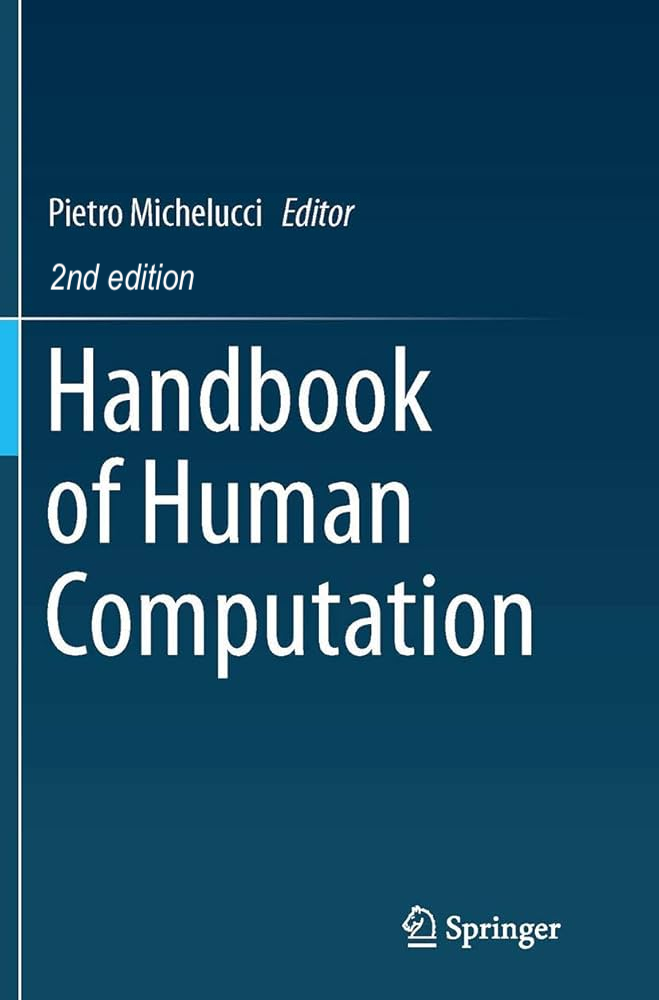
The first edition of the Handbook of Human Computation has seen over 280,000 downloads since it was published in 2013. We now embark on a second edition, to present new findings and anticipate the evolving role of humans-in-the-loop in the age of generative AI. Toward this end, we are inviting ideas and chapter proposals to help shape a new reference for this evolving field.
Get notifications about the workshop
HCOMP TOWN HALL: JOIN US
Shaping the Handbook of Human Computation, Second Edition
UPDATE: Our HCOMP/CI 2026 workshop has merged with "The Future of Research in the Age of Human-AI Collective Intelligence," organized by Senjuti Dutta, Alex Bentley, and Chuanren Liu. They have put together an awesome program, and we're honored to be part of it. Our Handbook work continues in a Town Hall right after their workshop, on Sunday, September 27, from 1:30 to 3:30 PM ET.
The first edition of the Handbook of Human Computation brought together more than 100 authors from academia, industry, and nonprofit organizations to define and document an emerging interdisciplinary field. Since its publication in 2013, the handbook has been downloaded more than 280,000 times and has served as a foundational reference for researchers, practitioners, and students.
Over a decade later, the landscape has changed dramatically. Generative AI, large language models, agentic systems, and increasingly sophisticated human-AI collaboration are transforming how people learn, create, decide, and solve problems together, even as the ACM HCOMP and Collective Intelligence communities converge around designing systems that combine the complementary strengths of humans and machines.
The Town Hall invites the community to help shape the Handbook of Human Computation, Second Edition (HCH2). Participants will learn about the handbook vision and editorial process, discuss where the field is headed, propose topics and chapters, and help build a community-driven roadmap for a new publication on the co-evolution of humanity and AI.
HOW TO JOIN
Town Hall: Sunday, September 27, 1:30-3:30 PM ET
If you can't register for the workshop, you can join us just for the Town Hall on Zoom. To get the link, email caroline@hcinst.org
The workshop before the Town Hall: Sunday, September 27, 9:00 AM-1:30 PM ET
"The Future of Research in the Age of Human-AI Collective Intelligence" includes invited talks, a poster session, and a roundtable where Pietro Michelucci will first introduce the Handbook at about 12:20 PM. Attending the workshop requires a paid conference registration. To register, sign up for HCOMP or CI and select "The Future of Research in the Age of Human-AI Collective Intelligence":
HCOMP registration: https://hcomp.acm.org/2026/registration.html
CI registration: https://ci.acm.org/2026/registration.html
Workshop schedule: https://sduyr.github.io/hai-ci-workshop-2026/
The workshop and the Town Hall are both in Room 5150, Virginia Tech Academic Building One, 3625 Potomac Ave, Alexandria, VA 22305.
HCOMP/CI 2026, the ACM Conference on Human-AI Complementarity and Alignment, runs September 27-30, 2026.
TOWN HALL PLAN
Welcome: why the HCOMP and Collective Intelligence communities are meeting together, and what HCH2 is.
Lightning talk: Shida Sharif-Bakhtiar follows up on her workshop poster. [Working title]
Discussion: the future of the field, and whether HCOMP and CI should become one Hybrid Intelligence community.
Shaping HCH2: topics, chapter ideas, and who wants to contribute.
Next steps: how to stay involved and submit proposals.
WHO, WHAT, WHEN, WHERE, AND HOW
The Town Hall focuses on collaboratively shaping HCH2 and identifying opportunities for community participation. Discussion topics include:
Who: section editors and editorial structure; opportunities to serve as chapter authors and shape the content and vision; strategies for broad representation across disciplines, sectors, career stages, and geographic regions; and building a contributor community that reflects the evolving Human Computation, Human-AI Complementarity, and Collective Intelligence communities.
What: proposed handbook themes, sections, and chapter topics; emerging research areas that should be represented; important developments since the first edition; topics that define the present and future of the field; and gaps, omissions, and opportunities for new perspectives in the new edition.
When: the timeline for handbook development; chapter proposal deadlines; the review and revision process; the expected publication schedule; and milestones and opportunities for participation throughout the project.
Where: online platforms and communication channels for contributor engagement; mechanisms for ongoing community discussion and collaboration; and resources for proposal submission, review, and handbook development.
How: the editorial philosophy and vision for the second edition; chapter formats and expectations; review criteria and editorial process; methods for incorporating community feedback; and approaches to maintaining broad participation and transparency throughout handbook development.
Participants will have opportunities to propose chapters, recommend contributors, and help shape the overall direction of the handbook.
WHO'S INVITED
The Town Hall is open to researchers, practitioners, educators, students, and industry professionals working in Human Computation, Human-AI Interaction, Collective Intelligence, Hybrid Human/AI Intelligence, Crowdsourcing, Citizen Science, Participatory Science, Computational Social Science, Human-Centered AI, and related fields.
RATIONALE
The first edition of the Handbook of Human Computation [1] captured the emergence of Human Computation as a coherent interdisciplinary field. The second edition arrives at a pivotal moment: increasingly capable AI systems are changing the nature of work, creativity, decision making, scientific discovery, and collective action, raising new questions about human agency, participation, governance, trust, labor, and societal impact.
Human Computation researchers have spent more than a decade developing theories, methods, and systems that combine human and machine capabilities, positioning the field to help shape the future role of humans in increasingly AI-mediated systems and societies.
The second edition seeks to capture this evolution in an era shaped by Human-AI Complementarity and Collective Intelligence. The Town Hall will present an initial vision while inviting participants to refine, expand, and strengthen it through diverse perspectives, emerging topics, broader representation, and community input.
Specific objectives are to:
Present the vision, structure, and editorial plan for HCH2.
Gather community feedback on proposed themes and section organization, and identify emerging topics and research directions that should be represented.
Recruit prospective chapter authors, section editors, and reviewers, and foster connections among researchers across Human Computation, Human-AI Collaboration, and Collective Intelligence.
Produce a community-informed roadmap to guide development of the handbook.
HANDBOOK VISION (you can help shape this at the Town Hall!)
In her foreword to the first edition of the Handbook of Human Computation, the late cultural anthropologist Mary Catherine Bateson wrote presciently that "Human computation for socially useful goals will depend on giving individuals a sense of agency – a sense that they indeed can make a difference." A decade later, the pervasion of powerful generative AI, which is already displacing humans in labor and the arts, challenges the future role of humans in architecting our individual and collective destinies. This only amplifies Dr. Bateson's imperative to preserve individual agency as "an essential aspect of human dignity."
At this critical juncture, the field of Human Computation is well-positioned to draw upon its methods and learnings to influence the future role of humans in a world that is increasingly reliant on AI. In particular, we can investigate designs that preserve agency. Our evolving understanding of the complementary strengths of humans and machines recognizes that human drives, goals, and real-world grounding position us well to steer artificial thinking systems toward our own objectives, effectively increasing our influence and impact in the world. We can also apply the methods of crowd wisdom and collective decision-making toward addressing the challenges of equitable access to these powerful new systems and their capabilities. More broadly, the convergence of human computation, artificial intelligence, and collective intelligence creates an opportunity to design hybrid systems that amplify not only individual agency, but our collective capacity to understand, decide, and act.
This second edition of the Handbook of Human Computation builds upon the foundations established in the first edition with a thematic and timely focus on human/AI complementarity and hybrid collective intelligence. As increasingly capable AI systems become embedded in nearly every domain of human activity, we expand the field's taxonomy to encompass novel configurations of humans and AI, from engineered systems that deliberately combine human and machine capabilities to emergent forms of hybrid collective intelligence operating at societal scale. Throughout the volume, we examine the evolving science of complementarity, asking not only how humans and machines differ, but how their differences can be combined to create systems that are more capable, resilient, and beneficial than either alone.
The chapters collected here explore new techniques and modalities including agentic AI, AI-assisted coding, AI-enabled scientific discovery, data science, augmented and mixed reality, and large-scale human-AI collaboration. They examine both the design of hybrid systems and the broader dynamics of collective intelligence arising from interactions among humans, AI agents, and institutions. Particular attention is given to identifying complementary strengths and limitations, understanding persistent human-AI capability gaps, and developing frameworks for effective collaboration among heterogeneous intelligences.
At the same time, the volume addresses the profound ethical, cultural, economic, and political questions raised by these developments. Contributors explore topics such as AI ethics and AI-assisted ethics, trust and trust calibration, creativity and authorship, the future of labor, governance, and the distribution of power and opportunity in increasingly automated societies. They ask what role human participation should play in systems that can increasingly act, decide, and create on our behalf, and how human values can remain central as intelligent technologies become more autonomous and pervasive.
Looking beyond present-day applications, this edition adopts a forward-looking perspective on the future of collective intelligence itself. It considers the possibility that future societies themselves may increasingly rely on hybrid collectives composed of humans, AI agents, institutions, and computational infrastructures working together toward shared goals. In such a world, traditional measures of success based solely on accuracy or efficiency may prove insufficient. Questions of agency, meaning, flourishing, creativity, participation, and societal well-being become increasingly important. Ultimately, this volume explores how the principles of human computation can help shape a future in which advances in artificial intelligence expand rather than diminish individual human agency as well as humanity's capacity to influence its own destiny.
TOWN HALL ORGANIZERS
Pietro Michelucci
Pietro Michelucci is the Executive Director of the Human Computation Institute. He is editor of the Handbook of Human Computation (1st Edition) and founding editor of the journal Human Computation. Trained in cognitive science and mathematical psychology at Indiana University, he advised U.S. federal research agencies on AI and emerging technologies for a decade, and in 2014 led the CRA-sponsored Human Computation Roadmap Summit at the Wilson Center, producing a national research roadmap for the field. His work focuses on hybrid human-AI intelligence, collective intelligence, citizen science, and systems that combine human and machine capabilities to address societal challenges.
Caroline Nickerson
Caroline Nickerson is Citizen Science Coordinator at the Human Computation Institute, where she supports outreach and community engagement for projects that combine human and machine intelligence for social good, including Stall Catchers, Beta Catchers, and Polymath Plus. She earned her PhD in Agricultural Education and Communication from the University of Florida, focusing on climate change communication, citizen science, and public education. She has held leadership and outreach roles with SciStarter and the CitSci platform and coordinated participatory science initiatives involving volunteers, researchers, institutions, nonprofits, and government agencies. Her expertise spans community building, science communication, participant engagement, workshop facilitation, and cross-institutional collaboration.
Shida Sharif-Bakhtiar
Shida Sharif-Bakhtiar is a PhD student at McGill University in the lab of Jérôme Waldispühl, co-supervised by Roman Sarrazin-Gendron. Her research focuses on Games With a Purpose (GWAPs) and the use of game and crowd-derived data for scientific annotation and downstream machine learning. Before her doctoral work, she spent several years in industry as a software developer and in startups. She has given talks on generative AI and software development. At HCOMP, she is presenting a poster at the morning workshop and speaking at the Town Hall.
Leon Li
Leon Li is a PhD student at McGill University in the lab of Jérôme Waldispühl. His work sits at the intersection of citizen science, immunology, and machine learning. He previously collaborated with SOULCAP and Ryan Brinkman on flow cytometry annotation through Project Discovery, a Game With a Purpose embedded in EVE Online that turned cell-population gating into gameplay for millions of players, generating annotation data at a scale no expert pipeline could match. He has also led workshops on generative AI and brings that hands-on facilitation experience.
HOST WORKSHOP ORGANIZERS
Senjuti Dutta, Alex Bentley, and Chuanren Liu, organizers of "The Future of Research in the Age of Human-AI Collective Intelligence."